 (The Record of Hackensack, N.J., 5/15/2003)
 c. 2003 North Jersey Media Group
By Lisa Haddock
Dr. Miryam Z. Wahrman is a born teacher.
"I walked into a classroom and I got bitten by that bug. I've always had this desire to bring science to people - to be able to translate it in such a way so that it is palatable and it's accessible," she says.
As if to illustrate her point, the biology professor had just scraped the inside of her cheek with a cotton swab and prepared a slide for viewing under the microscope at her lab at William Paterson University in Wayne.
With great enthusiasm, she explained where DNA is found within the cell structure.
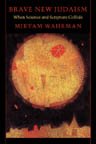
Wahrman's desire to educate others about the issues that fascinate her - her Jewish faith, the Talmud, science, research, and bioethics - drove her to write Brave New Judaism: When Science and Scripture Collide (Brandeis University Press, 2002).
Her book is an elaborate patchwork of ancient and modern Jewish thought, esoteric Talmudic discourse, cutting-edge biotechnology, and heart-wrenching dilemmas faced by everyday people.
"My heart and soul were in this book. The things I write about were burning inside me," says Wahrman, who also writes about science and Judaism for the New Jersey Jewish Standard, the Jewish Community News, and America Online.
Wahrman named her book after Aldous Huxley's 1932 novel Brave New World. Huxley painted a grim future in which genetic engineering determines every individual's fate. Each baby is hatched in a lab and programmed for one of five classes, grouped by intelligence.
Despite borrowing Huxley's title, she rejects his pessimism.
"The issues [I raise] are issues that Huxley addressed. But I don't think it's a negative world. It's a world where there is a lot of promise," Wahrman says.
As for lab-created babies, Wahrman is a pioneer in the field. On the wall of her tiny office, there are pictures of the first test-tube baby born in New York, before and after birth.
Before coming to William Paterson in 1984, Wahrman was part of the team that helped bring this baby into the world.
Wahrman, who is Orthodox, examines more than her own community's perspectives in Brave New Judaism. The Teaneck resident also presents Conservative and Reform views.
Key Jewish ethical principles are repeated throughout the book, including mandates to have children, to heal others and to seek healing for oneself, to avoid causing pain, to repair the world's problems, to take precautions to avoid accidents, to treat animals humanely, to avoid destruction of the environment, and to preserve human life.
Wahrman applies these principles - interpreted by ancient sages and modern experts - to a wide array of issues, including surrogate motherhood, human cloning, stem-cell research, gender selection of children, genetically modified foods, and abortion of fetuses with birth defects.
Wahrman shows that opinions vary among rabbinic authorities and sometimes even within denominations.
Rabbi Dr. David Feldman, a leading bioethics expert who is cited frequently in Brave New Judaism, salutes the book as "a skilled presentation of both classic and emerging issues in Jewish medical ethics."
"Dr. Wahrman blends expertise with experience to produce a vital and highly readable volume," says Feldman, rabbi emeritus of the Jewish Center of Teaneck and dean and founder of the Jewish Institute of Bioethics, also in Teaneck.
Despite Wahrman's firm belief that biotechnology can improve human life and the natural world, she believes scientists must follow appropriate moral guidelines.
"Not every application [of biotechnology] is warranted," says Wahrman, a member of Congregation Rinat Yisrael in Teaneck.
For example, Wahrman believes cloning humans is too risky for now. Jewish law would permit the process only if it is highly likely to produce healthy children, she says.
And the topic of gender selection disturbs her greatly.
"I can't get my mind around it - the fact that people would actually do something to reject a gender in favor of another gender," says the mother of two teenage daughters. Her book documents high rates of abortion of female fetuses in India, China, and Korea.
"I am very interested in the misuse of science," says Wahrman, who is co-director of WPU's Center for Holocaust and Genocide Studies.
"The programs that the Nazis did regarding eugenics - the genetic selection of people - relate to some of the things we're talking about today," says Wahrman.
Despite her concerns, Wahrman is unfazed by anti-technology arguments. "This is part of our lives," she says. "We should always be hopeful that we can improve the quality of human life and the natural world."
Wahrman is working, as well, to improve the quality of her intellectual life. Like many Jewish women of her generation, Wahrman, 47, was not exposed to advanced Talmudic study when she was young. The Talmud, a vast body of Jewish wisdom, is made up of the Mishna, ancient interpretations of the Scriptures; and the Gemara, which comments on the Mishna.
As a schoolgirl, she was taught the Mishna.
Throughout her adulthood, she sporadically studied both parts of the Talmud. But about two years ago, her husband, Israel Wahrman, began teaching her a page of the Gemara every Sabbath.
Despite her enthusiasm for her work and learning in general, Wahrman acknowledges that managing her many duties is a juggling act.
"Thank God, I have my health, I have energy, I have a terrific family who support me in every way, and I have wonderful people I work with," she says.
When pressed for more details on how she accomplishes so much, she quips: "I'll introduce you to my clone."


